
About us
We provide emergency shelter to people who have lost their home to disaster, enabling them to rebuild their lives.

The news of a ceasefire in Gaza offers hope to 2 million Palestinians who have endured years of what the UN has declared a genocide.
1.4 million people urgently need support. ShelterBox and our partners are ready to provide emergency shelter to thousands of families as soon as access is granted.
People in Gaza have been trapped, with nowhere safe to go, nowhere to live, and little to eat.
This ceasefire must be permanent. Aid must flow freely to prevent further trauma, famine, violence and death.
Almost 2 million people are currently displaced across Gaza. With famine looming, many continue to be displaced repeatedly – often with no adequate shelters left to move to. Nine in ten people in Gaza have already been displaced at least once. Now, there are even fewer places left to go.
Thousands of people are fleeing again under Israeli airstrikes and plans to move civilians from Gaza City to so-called “safe zones” in the south. Many are walking, carrying what little they have but not everyone can go – those who are injured, elderly, or disabled. People are starving and no where is safe.
Since October 2023, over 90% of homes have been damaged or destroyed, and much of the region’s farmland has been bombed. As a result, communities are now almost entirely dependent on humanitarian assistance. Every day, more civilians are being killed. They must all be protected – along with the critical infrastructure they rely on – humanitarian warehouses, medical clinics, and water systems.
The lives and human rights of millions of Palestinian people who live in Gaza, and the hostages, must be protected.
For nearly three months, Israel blocked all humanitarian aid. In May, following international pressure, it designated the Gaza Humanitarian Foundation (GHF) as the sole authorised aid provider within the territory. Hundreds of civilians have reportedly been shot dead by Israeli soldiers while waiting for food assistance, and thousands more have been injured.
Although some shelter aid – including tents – will be allowed into Gaza via Israel, most aid is still being blocked. Most humanitarian organisations, including ShelterBox, cannot move any aid.
This dark and inhumane chapter is unfolding in plain sight, in front of the entire world, and it must be brought to an end. Do not stop talking about Gaza.
Three colleagues with the Palestinian Agricultural Development Association (PARC) – one of our long-standing partners in Gaza – have been killed in recent Israeli attacks. Batoul Abu Samra was killed in an Israeli airstrike on July 1, the same day nearly her entire family were killed, Haitham Juma was killed on 2 June, and Ahmed Saad was killed in an airstrike on his home in Gaza City on June 27, along with members of his family.
Our thoughts and deepest condolences remain with their families, friends, and our colleagues at PARC. We stand with them in grief and solidarity. Their deaths are a stark and painful reminder of the grave and unacceptable dangers faced by civilians and humanitarian workers in Gaza.
These risks continue despite protections explicitly guaranteed under international humanitarian law. We unequivocally condemn all violence against humanitarian workers – individuals who dedicate their lives to serving others. Their protection and that of all civilians must be non-negotiable. The humanitarian response must not be impeded. Lifesaving aid must be allowed to reach those in need – safely, swiftly, and without interference.
We continue to call for an immediate end to the violence and for all parties to uphold their obligations under international law. The human suffering in Gaza must end.
reflections from PARC colleagues
The ceasefire in Gaza has collapsed after being broken by Israel. On the 18th March, 2025, Israeli airstrikes resumed on Gaza. Since then, Israel has intensified its military attacks, killing tens of thousands.
The fragile ceasefire had brought hope to vulnerable families in desperate need of safe shelter, food, water and medical care. Now, people are once again left searching for safety.
Most of the aid that we had in Gaza before the blockade has now been distributed by our partners PARC, MAP, and SDF. Temporary and portable shelter items like tents, tarpaulins, and rope allow people to create temporary homes.
We have more aid in Jordan ready to go, and enough tents to shelter thousands of people, but we can’t move it because of the ongoing restrictions. A permanent ceasefire and end to the fighting is the only way to ease the immense suffering on Palestinians in Gaza and protect their human rights.
Read this recent article from Jonty Ellaby, our programme manager for Gaza, on the situation in Gaza, and why a ceasefire is fundamental.
Read this personal account
After blocking aid for 11 weeks, on Monday (19 May), due to external pressure, Israel began to allow a trickle of aid to cross the border. The Israeli and US-backed Gaza Humanitarian Foundation (GHF) is the only approved aid distributor in Gaza. GHF gives out food and supplies, but only through four checkpoints in the south. These places are controlled by soldiers and are hard for many people, especially those living in the north, to reach. Many aid groups say this system dangerous, politically motivated and inadequate.
Hundreds of Palestinians have been killed while trying to access this limited aid, and thousands have been injured. There have been reports of civilians being shot at while waiting for food. This has contributed to an intense climate of fear around accessing humanitarian support. Deliberately preventing the access of lifesaving aid is being used as a weapon. People are dying slowly – from disease, the lack of food, clean water, and medical supplies.
For the first time in months, some shelter aid – including tents – will be allowed into Gaza via Israel. But most aid is still blocked. And most humanitarian organisations, including ShelterBox, cannot move aid supplies. ShelterBox has been working with local partners, who were already present in Gaza, and are closely monitoring the situation.
After blocking aid for 11 weeks, on Monday (19 May), due to external pressure, Israel began to allow a trickle of aid to cross the border. The Israeli and US-backed Gaza Humanitarian Foundation (GHF) is the only approved aid distributor in Gaza.
GHF gives out food and supplies, but only through four checkpoints in the south. These places are controlled by soldiers and are hard for many people, especially those living in the north, to reach. Many aid groups say this system dangerous, politically motivated and inadequate.
Hundreds of Palestinians have been killed while trying to access this limited aid, and thousands have been injured. There have been reports of civilians being shot at while waiting for food. This has contributed to an intense climate of fear around accessing humanitarian support.
Deliberately preventing the access of lifesaving aid is being used as a weapon. People are dying slowly – from disease, the lack of food, clean water, and medical supplies.
For the first time in months, some shelter aid – including tents – will be allowed into Gaza via Israel. But most aid is still blocked. And most humanitarian organisations, including ShelterBox, cannot move aid supplies. ShelterBox has been working with local partners, who were already present in Gaza, and are closely monitoring the situation.
Access to shelter aid in Gaza is still severely blocked. While a few approvals have happened, most requests are still being rejected. There’s a clear pattern of obstructing humanitarian aid. Although over one million tarpaulins and 86,000 tents have been sourced by humanitarian organisations, very few have made it in.
Since the announcement, only 1,175 tents have entered Gaza. At this rate, it would take five months to meet current needs – about as long as the materials will last.
On 17 August, Israel said tents and shelter materials could enter as part of a plan to move civilians south ahead of a military operation. This goes against humanitarian principles and international law.
At ShelterBox, we are committed to helping people where they are, not directing their movement. But the gap between what’s needed and what’s allowed in is growing. Our aid is ready – but blocked.
Approvals should not be mistaken for access. Since 2 March, only a trickle of shelter items has entered Gaza. Conditions on the ground are dire.
People are living in overcrowded, unsafe spaces. Over 1.4 million people urgently need shelter and basic household items. Without urgent change, the coming winter will make an already unbearable situation even worse.

Our aid continues to be blocked from entering Gaza due to Israeli aid restrictions. We continue to call for a sustained ceasefire and full aid access into Gaza. We must be able to distribute our aid supplies and support the thousands of people living without shelter.
Prior to aid blockages, we were providing tents and other emergency items to support people in Gaza. Together with MAP (Medical Aid for Palestinians) and SDF (the Social Development Forum), we distributed tents, tarpaulins, rope, tape and plastic sheeting to make shelters watertight. We also supported people with kitchen sets, bedding and hygiene kits.
Right now, 30,000 tents are stuck in Jordan, and have been for months, including those we have stored in Amman with our partner PARC. All restrictions must be lifted. We remain ready to get more tents into Gaza with PARC as soon as we’re allowed.
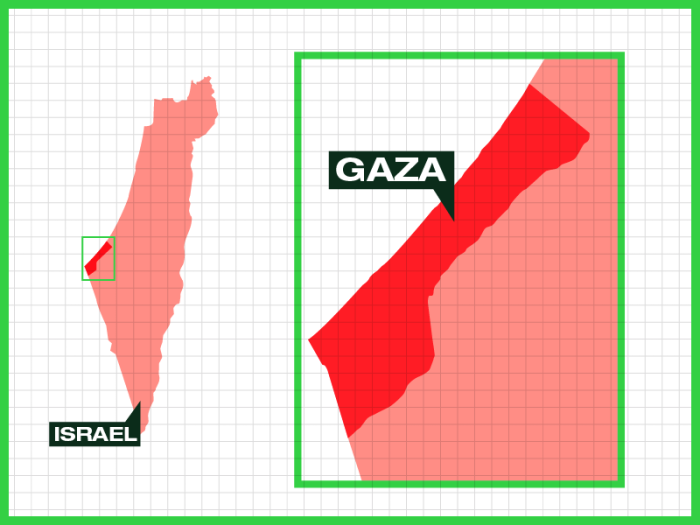
The Gaza Strip is located on the eastern coast of the Mediterranean Sea. It is bordered by Egypt on the southwest and Israel on the east and north.
Gaza is one of the most densely populated places in the world. Before October 7th, Gaza was home to approximately 2.3 million people across just 141 square miles (41km wide by 10km wide). Since then, the exact number of people alive after months of airstrikes, destruction and starvation is unknown.
Families are unable to leave Gaza. Forced to move again and again in search of safety. But land, sea and air bombardments are making that near impossible. There are large areas cut off and people are continuously on the move.